


Revenue leakage
Recurring execution gaps weaken multiple opportunities and reduce conversion.
Sales organizations can see more customer interactions than ever before. But seeing what happened does not mean the salesperson received the right feedback, practiced a better response or changed their behavior.
Read The Case for Continuous Sales Coaching and identify where your organization's improvement loop is breaking.
Request the White PaperThe Coaching Gap is the inability of a traditional manager-led model, on its own, to deliver sufficiently frequent, consistent and personalized development to every salesperson.
Conversation intelligence addressed an important problem. It made previously invisible customer interactions visible.
The remaining challenge is converting that evidence into changed behavior.



The loop only closes when measurement feeds the next round of practice
The improvement loop commonly breaks after insight, when evidence must be converted into practice, application and measurable behavior change.
| The organization can see | But can it prove |
|---|---|
 A discovery question was missed A discovery question was missed |  The rep knows what to ask instead The rep knows what to ask instead |
| A manager provided feedback | The behavior actually changed |
| A call was scored | Underlying capability is improving |
The distinction is not between good technology and bad technology. It is between insight infrastructure and a continuous improvement system.
Weak coaching rarely appears as one visible line in the sales budget. Its cost is dispersed across missed opportunities, delayed ramp, management time and inconsistent execution.
Recurring execution gaps weaken multiple opportunities and reduce conversion.

New hires learn through live customer interactions and irregular feedback, delaying productivity.

Managers repeat foundational feedback, search for calls and rescue deals in ways that do not scale.

Methodology, messaging and commercial priorities fail to show up consistently in customer interactions.
The cost of inaction is not static.
It compounds with every sales interaction.
Review the assumptions and apply the exposure model to your own sales
organization.
Feedback often arrives after the same problem has affected several interactions. Reps are forced to learn how to handle unfamiliar scenarios with real customers, coaching varies between managers and progress in underlying capability is difficult to see.
Managers are expected to identify the right interaction, diagnose the issue, explain the alternative, create practice and confirm follow-through while also forecasting, recruiting and supporting deals.
A manager may help progress the current opportunity without making the rep more capable of progressing the next one independently.
Revenue data shows that a problem exists. It does not always identify whether the underlying issue is activity, talent, execution, coaching or market conditions.
| What the leader sees | What the leader still needs to understand |
|---|---|
| Win rate declined | Which behaviors changed? |
| Sales cycles lengthened | Are reps failing to create urgency or reach the right stakeholders? |
| A team is underperforming | Is the issue talent, coaching or market conditions? |
Call recording, AI summaries and scorecards create visibility. Continuous coaching requires evidence that feedback is frequent, applied, measured and reinforced.
Coaching occurs during onboarding, performance issues and occasional one-on-ones.
Conversations are captured and analyzed, but insights do not consistently become action.
A methodology, scorecards and coaching processes exist, but execution remains constrained by manager capacity.
Every rep can practice, receive feedback and measure progress regularly.
The most important issue is not the total score.
It is where the improvement loop breaks.
Complete the full ten-point Continuous Coaching Maturity Assessment.
Pitstop connects practice, feedback, application, measurement and reinforcement, helping sales teams move from seeing execution gaps to changing behavior.
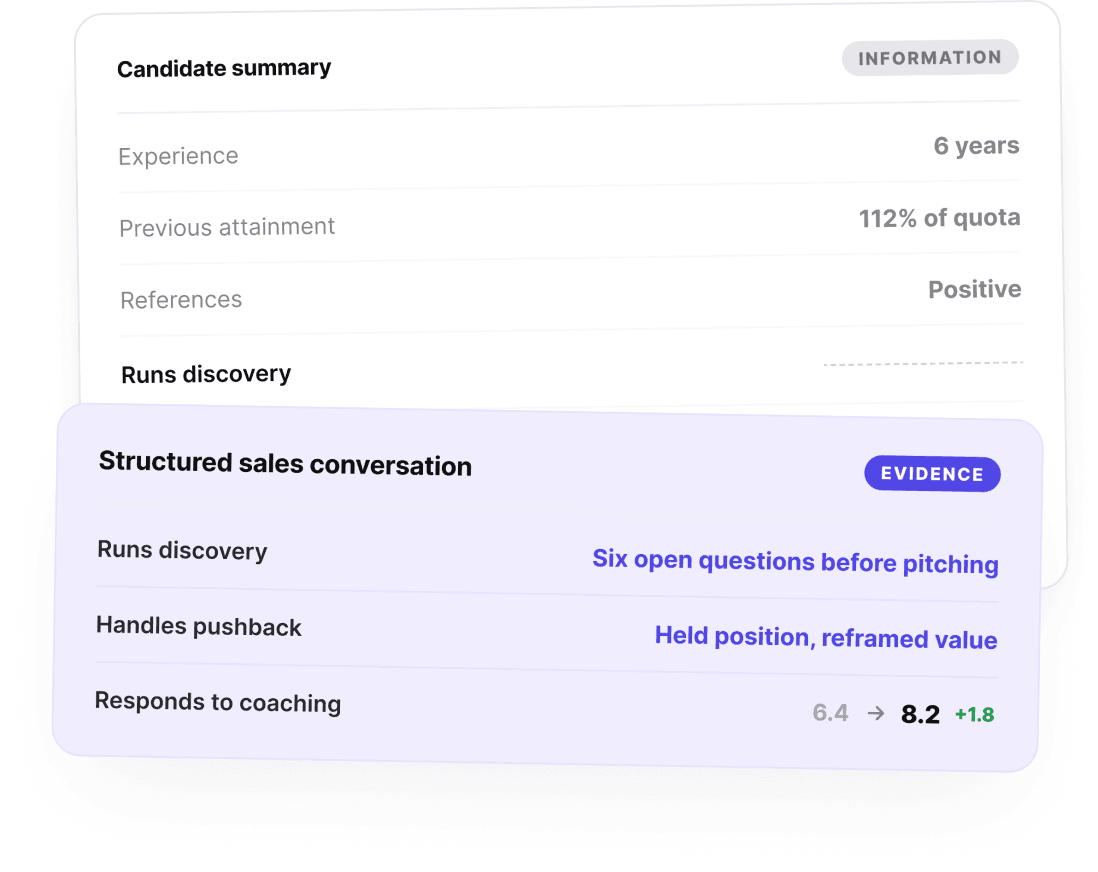
Traditional hiring provides plenty of information about a candidate, but limited direct evidence of how they sell or how they respond to coaching.
A structured sales conversation adds something different: evidence of how somebody actually performs - and what happens when they receive coaching and try again.
Capability tells you what they can do today. Coachability shows how they respond to improvement.
Why visibility into sales conversations is not the same as continuous improvement.
The white paper includes:
 The commercial case for continuous coachingAn illustrative economic exposure modelThe impact on reps, managers and leadersThe full ten-point maturity assessmentDetailed sources and research notes
 TAKE A PITSTOP
Try Challenge now to practice realistic sales conversations with AI. When you want coaching and measurement built around how your organization sells, DM Founder about your Company Standard.
